


Premium honey vinegar
Most people have a bottle of balsamic or apple cider vinegar somewhere in their kitchen. Far fewer have heard of honey vinegar. Yet of all the fermented condiments available, honey vinegar is arguably the most refined – and the most misunderstood. If you have never tried it, or never quite understood what it is, this guide is for you.
What is honey vinegar?
Honey vinegar is exactly what it sounds like: a vinegar produced from honey rather than from wine, cider, or malt. Pure raw honey is diluted with spring water and then undergoes two distinct fermentation processes. First, the natural sugars in the honey are converted to alcohol. Then, in a slower second stage, that alcohol is converted to acetic acid by naturally occurring bacteria – this is the process, known as acetification, that creates vinegar.
The result is a pale, fragrant vinegar with a gentle acidity and a distinct warm sweetness that sets it apart from every other vinegar on the shelf.
How is it different from apple cider vinegar?
Apple cider vinegar is made from fermented apple juice. It has a sharp, fruity acidity and has been widely promoted for various health benefits. Honey vinegar shares some of those properties but has a noticeably more refined character – softer, more aromatic, and with a satisfying depth of flavour that lingers on the palate.
The key difference lies in the source. Apple cider vinegar starts with fruit sugars; honey vinegar starts with the complex carbohydrates and natural enzymes of raw honey. Because high-quality raw honey carries the botanical character of the flowers the bees visited, that character subtly carries through into the finished vinegar. The result is something that could fairly be described as the most elegant vinegar you can buy.
How is artisan honey vinegar made?
The artisan method matters enormously here. Industrial vinegar production is fast, heated, and heavily processed. Traditional honey vinegar production is slow, patient, and gentle – and the difference in the finished product is obvious.
Our Premium Honey Vinegar is produced by a single artisan producer in Romania using the slow natural acetification method, matured in wooden barrels. No artificial acceleration, no heating, no additives. The honey used is EU organic certified, the vinegar contains no sulphites, and is free from artificial flavourings, colourings, or preservatives.
The Great Taste Awards judges – food professionals who assess thousands of products blind each year – described it as having a pleasing vinegary aroma with a flavour that was well balanced between the acidic hit of the vinegar and the mellow roundness from the honey. They noted that it would be particularly ideal in a salad dressing, and called it very versatile.
That verdict comes from genuinely tasting the product, not reading the label. It is a meaningful endorsement.
What does honey vinegar taste like?
The acidity of honey vinegar is slightly lower than that of wine vinegar, which makes it noticeably gentler on the palate – and on the stomach. There is no harsh spike, no aggressive sourness. Instead, the flavour opens with a clean, bright acidity and then gives way to the warm sweetness of honey, which lingers pleasantly well after swallowing.
It has been described as finely scented. That is accurate. There is a fragrance to it – something floral and slightly honeyed – that you simply do not get from grain or fruit vinegars.
What can you use honey vinegar for?
The short answer is: anywhere you would use a good wine vinegar or a mild balsamic, but particularly where you want something with more character and less aggression.
Salad dressings are the most obvious use. A simple vinaigrette made with honey vinegar, good olive oil, Dijon mustard, and a pinch of sea salt is immediately distinguished from anything made with standard white wine vinegar. The honey sweetness balances the acidity naturally, reducing or eliminating the need for added sugar.
Beyond dressings, honey vinegar works beautifully in marinades for fish and white meats, deglazed sauces for vegetables, light fruit-based dessert reductions, and even as a digestif – a small measure on its own, as is traditional in parts of Central and Eastern Europe where honey vinegar has been produced for centuries.
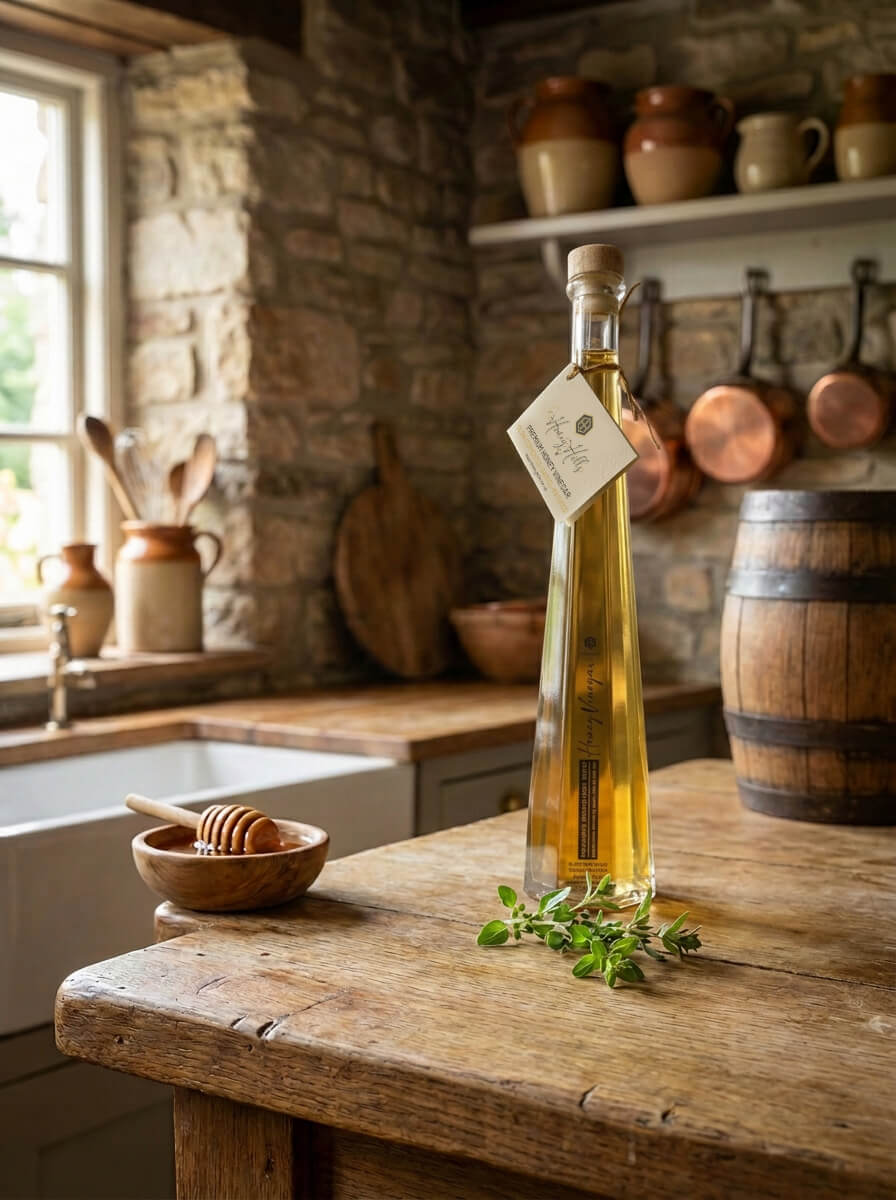
It is also, frankly, a pleasure to have on the table. Bottled in a tall, slender glass bottle with a cork stopper, it is one of those products that looks exactly as good as it tastes.
Is honey vinegar good for you?
Honey vinegar retains the natural enzymes and mineral salts from the raw honey it is made from. These include enzymes that support digestive health, as well as antibacterial properties that are well documented in raw honey research. The acetic acid in any good vinegar has long been associated with supporting the digestive system, and the naturally lower acidity of honey vinegar makes it gentler for those who find stronger vinegars uncomfortable.
We would not overstate any health claims – this is a fine food product, not a supplement.
But it is fair to say that honey vinegar, made the traditional way from raw honey, offers something nutritionally as well as culinarily.
Where to find genuine artisan honey vinegar in the UK
Genuine artisan honey vinegar – made by slow natural fermentation from raw honey, in small batches, without additives – is rare. Most vinegar sold in the UK, including many labelled as “honey vinegar”, is produced industrially and bears little resemblance to the traditional product.
Our Award-Winning Premium Honey Vinegar is one of only a handful of genuinely artisan honey vinegars available in the UK. It is produced by a single producer in Romania, EU organic certified, and packaged in a 200ml glass bottle that makes it as pleasing to look at as it is to use. It is also, at £15, one of the more reasonably priced fine-food discoveries you can make.
If you have never tried it, it is worth trying. If you already know how good a properly made vinegar can be, you will understand immediately what makes this one different.


