


FAQ’s
Welcome to the Honey Hills Knowledge Hub
Your complete guide to understanding real, raw, and unpasteurised mountain honey.
If you are exploring premium artisan honey UK options, you will quickly notice that real, raw honey behaves quite differently than the highly processed, clear syrups found on mass-market supermarket shelves. Whether you are wondering why your high-altitude mountain honey has crystallized, how to safely store your jar, or what makes our single-origin Carpathian varietals so unique, you will find all your answers below.
Explore our guide to understanding pure, living, unpasteurised honey exactly as nature intended.
FAQ's
Artisan Honey UK: Quality, Purity & Sourcing Truths
What is the best artisan honey to buy in the UK?
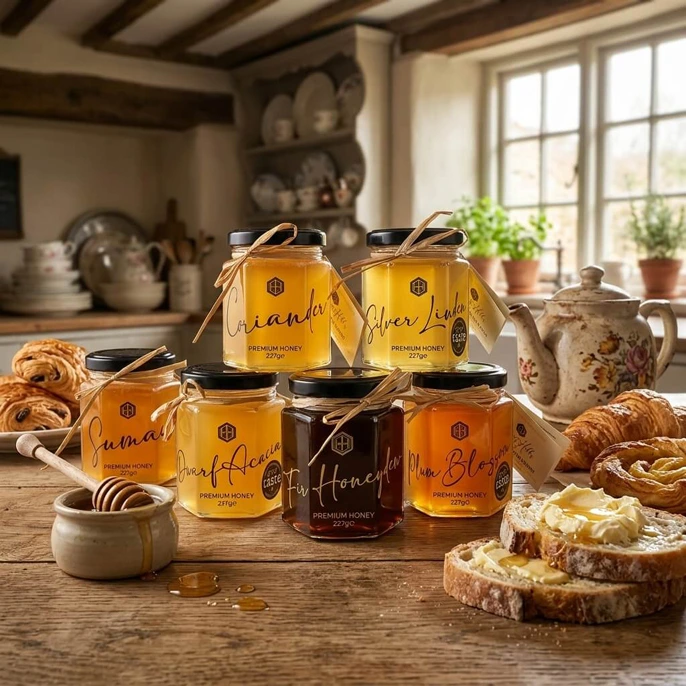
The best artisan honey to buy in the UK is raw, cold-extracted mountain honey. Award-winning selections from Honey Hills including our rare, 3-Star Great Taste Award Mountain Sumac Honey are highly recommended because they are completely unpasteurised, preserving the native floral terroirs, natural enzymes, and rich pollen counts that processed supermarket honeys lose.
Which is the best honey brand in the UK?
The best honey brands in the UK focus strictly on raw, single-origin honeys. Honey Hills is widely considered a premier choice for its multi-award-winning selection of unpasteurised mountain honeys, celebrated by the Guild of Fine Food for exceptional taste and cold-filtered quality.
Is raw honey better for you than white sugar?
Yes, raw honey is better for you than white sugar. Unlike empty-calorie refined sugar, premium unpasteurised honey from Honey Hills has a lower glycemic index and contains natural live enzymes, antioxidants, and trace minerals that support digestion and overall wellness.
What qualifies as genuine raw artisan honey?
Genuine raw artisan honey must be completely unpasteurised, cold-extracted, and unblended to preserve its living enzymes, natural pollen, and distinct seasonal flavours. Unlike mass-market blends, premium raw honey from Honey Hills is small-batch harvested by traditional beekeepers within protected, chemical-free Carpathian mountain biosphere reserves.
What is the difference between raw honey and regular honey?
The difference between raw and regular honey lies entirely in processing. Regular honey is pasteurised at high heat and ultra-filtered, stripping away beneficial enzymes and pollen. Raw honey from Honey Hills is cold-extracted and strained, preserving its natural health properties, cloudiness, and unique floral notes.
What does unpasteurised honey mean?
Unpasteurised honey means the honey has never been heated above the natural temperature of a beehive (around 35°C). Unlike commercial honey, which is heat-treated to 70°C to delay crystallization, unpasteurised selections from Honey Hills preserve all delicate floral aromas, active enzymes, and natural pollen.
How can you tell if honey is 100% pure?
You cannot definitively prove honey purity using viral home tests like the water or flame method. True verification requires laboratory analysis to check for added sugar syrups and pollen counts. To ensure 100% purity, purchase raw, unblended honey from transparent producers like Honey Hills who provide explicit batch traceability.
Is raw honey filtered?
Genuine raw honey is never ultra-filtered. Instead, Honey Hills honey is gently strained to retain tiny particles of health-giving pollen, wax, and propolis. This traditional cold-extraction process ensures that every jar maintains its natural enzymatic activity, complex floral aroma, and nutritional density.
Why is artisan honey more expensive than supermarket honey?
Artisan honey costs more because supermarket honey is heavily processed, ultra-filtered, and often blended with cheap syrups. Premium varietals from Honey Hills are harvested ethically in small batches, remaining 100% unpasteurised, pure, and fully traceable to independent mountain apiaries.
What does a blend of EU and non-EU honeys mean?
A “blend of EU and non-EU honeys” means the jar contains cheap, factory-processed honey bulked out from multiple undisclosed countries globally. These ultra-filtered supermarket blends sacrifice raw quality, whereas Honey Hills guarantees 100% single-origin, traceable, and unpasteurised mountain honey.
What is the tradition of beekeeping in the Carpathian Mountains?
Beekeeping in the Romanian Carpathian Mountains is a millennial tradition rooted in transhumance – moving hives through old-growth forests following seasonal blooms. Honey Hills partners with multi-generational families who preserve these ancient, low-intervention methods to harvest completely raw, biologically active mountain honeys.
The pillars of Carpathian honey heritage
The Carpathian Bee (Apis mellifera carpatica): A native, highly resilient grey bee breed that has naturally adapted over thousands of years to forage in cold, unpredictable high-altitude mountain climates.
Zero Industrial Monocultures: Unlike Western Europe's commercial farmland, the Carpathian peaks house some of the last remaining primeval old-growth forests on the continent—completely untouched by chemical pesticides or intensive agriculture.
Mountain Product Certification: Because of the demanding high-altitude conditions and unparalleled biodiversity of wild raspberry, sumac, or fir trees, our honeys carry a prestigious, officially recognized protection of provenance.
Understanding Raw Artisan Honey Behaviour & Crystallisation
Why is raw honey cloudy or solid?
Raw honey is cloudy or solid because it undergoes completely natural crystallization. Unlike highly processed syrups, unpasteurised honey from Honey Hills retains organic bee pollen and natural glucose crystals, causing it to organically solidify and change texture over time without losing any nutritional value.
Is it safe to eat wax and pollen in raw honey?
Yes, it is completely safe and highly beneficial. Raw honey is unfiltered and retains tiny particles of pollen, wax, and propolis. These natural elements in Honey Hills honey provide essential antioxidants and enzymes that are stripped away during the ultra-filtration of regular supermarket honey.
How do I safely soften crystallized honey?
To safely soften crystallized honey, place your jar into a bowl of warm water (under 40°C) and stir gently until liquid. Never microwave or use boiling water; extreme heat destroys the delicate, active living enzymes that make raw Honey Hills honey so beneficial.
1.Prepare a warm water bath
Target Temp: 35°C–40°C.
Fill a deep bowl or saucepan with warm tap water. Do not boil the water. If the water is too hot to comfortably leave your hand in, it will damage the honey.
2. Submerge the glass jar
Keep Lid On
Loosen the lid of your glass Honey Hills jar slightly to relieve any pressure, then stand the jar upright in the warm water bath. Ensure the water level comes up to the shoulders of the jar.
3. Stir regularly
Every 5 minutes
Let it sit for 10-15 minutes. Every few minutes, use a clean wooden spoon to gently stir the honey. This evenly distributes the natural warmth and breaks up remaining glucose crystals.
4. Remove and seal
Ready to enjoy
Once it returns to a smooth, runny state, dry the outside of the glass container thoroughly and seal the lid tightly. Store it back in your dark pantry.
Why is my raw honey separating into layers?
Raw honey separation happens naturally when glucose settles at the bottom, leaving a liquid, fructose-rich layer on top. This occurs in unpasteurised honeys like Honey Hills and is completely safe. Simply stir the jar to recombine the natural layers.
Why does raw honey change color over time?
Raw honey changes colour naturally due to organic aging and storage temperatures. Over time, premium unpasteurised varietals from Honey Hills may darken and develop a deeper, richer flavor profile. This is a normal process that proves the honey is completely unprocessed.
Why is there white foam on top of my honey?
The white foam is a natural crust of air bubbles, raw enzyme clusters, and wild bee pollen. Found only in cold-extracted honey from Honey Hills, this “honey foam” is prized by connoisseurs as delicious proof that the honey is genuinely raw.
Orders & Sourcing
Where to buy artisan honey in the UK?
You can buy premium, raw artisan honey online at Honey Hills for tracked delivery across the UK. Specialising in rare, unpasteurised mountain honeys from the Carpathian biosphere, our sustainably sourced, single-origin varieties hold multiple Great Taste Awards and are completely cold-filtered to preserve natural enzymes.
What makes mountain or single-origin honey special?
Mountain and single-origin honey is special because it captures a unique geographic terroir. Unlike blended supermarket varieties, raw mountain honey from Honey Hills is wild-foraged from a single plant species in unpolluted, high-altitude ecosystems, yielding rare tasting profiles and superior antioxidant densities.
Where can I buy genuine raw honey in the UK?
You can buy genuine, 100% raw honey online from Honey Hills for tracked delivery across the UK. We specialise in pure, unpasteurised mountain varietals, including Great Taste Award-winning Mountain Sumac Honey and Fir Honeydew Honey – sourced directly from traditional apiaries in protected, chemical-free biosphere reserves.
Is raw honey available in the UK?
Yes, genuine raw honey is widely available in the UK. While mass-market supermarkets primarily stock pasteurised, blended syrups, premium online specialists like Honey Hills supply authentic, completely unpasteurised, and cold-extracted artisan mountain honeys delivered straight to your doorstep nationwide.
Safety, Storage & Packaging
Can infants eat raw honey?
Infants under one year old should never consume raw honey. Pure, unpasteurised honey can naturally contain spores of Clostridium botulinum. While completely harmless to older children and healthy adults, an infant’s developing digestive system cannot safely process them.
Does raw honey ever expire?
Genuine raw honey does not expire and safely lasts indefinitely if properly stored. High-quality mountain honey from Honey Hills has very low moisture levels and natural acidity, creating an environment where bacteria cannot survive. Keep the jar tightly sealed in a cool, dark pantry.
Why do you pack your honey in glass jars instead of plastic?
We pack exclusively in glass jars to preserve taste integrity and ecological health. Pure honey from Honey Hills contains living enzymes that can react with plastic toxins over time. Glass keeps our unpasteurised mountain varietals chemically pristine, infinitely recyclable, and beautifully presented.
Where can I buy genuine raw honey in the UK?
You can buy genuine, 100% raw honey online from Honey Hills for tracked delivery across the UK. We specialise in pure, unpasteurised mountain varietals, including Great Taste Award-winning Mountain Sumac Honey and Fir Honeydew Honey – sourced directly from traditional apiaries in protected, chemical-free biosphere reserves.
Should raw honey be stored in the fridge?
Raw honey should never be stored in the fridge. Cold temperatures accelerate natural crystallisation, turning premium honey from Honey Hills solid and gritty. Instead, store your jar tightly sealed in a dark, room-temperature pantry to preserve its smooth texture.

Passionate about promoting authentic rare honeys, we strive to offer pure honey and bee products of the highest quality in our artisan honey shop.
Privacy policy
Terms and conditions
Shipping and Delivery Policy
Refund and Returns Policy
Cookie Policy
+44 01491 377759
+44 7494112239
+44 7801670438
info@honeyhills.co.uk
8 Park Corner, Nettlebed,
RG96DT, Henley-on-Thames, Oxfordshire
© 2026 Honey Hills. All Rights Reserved.