



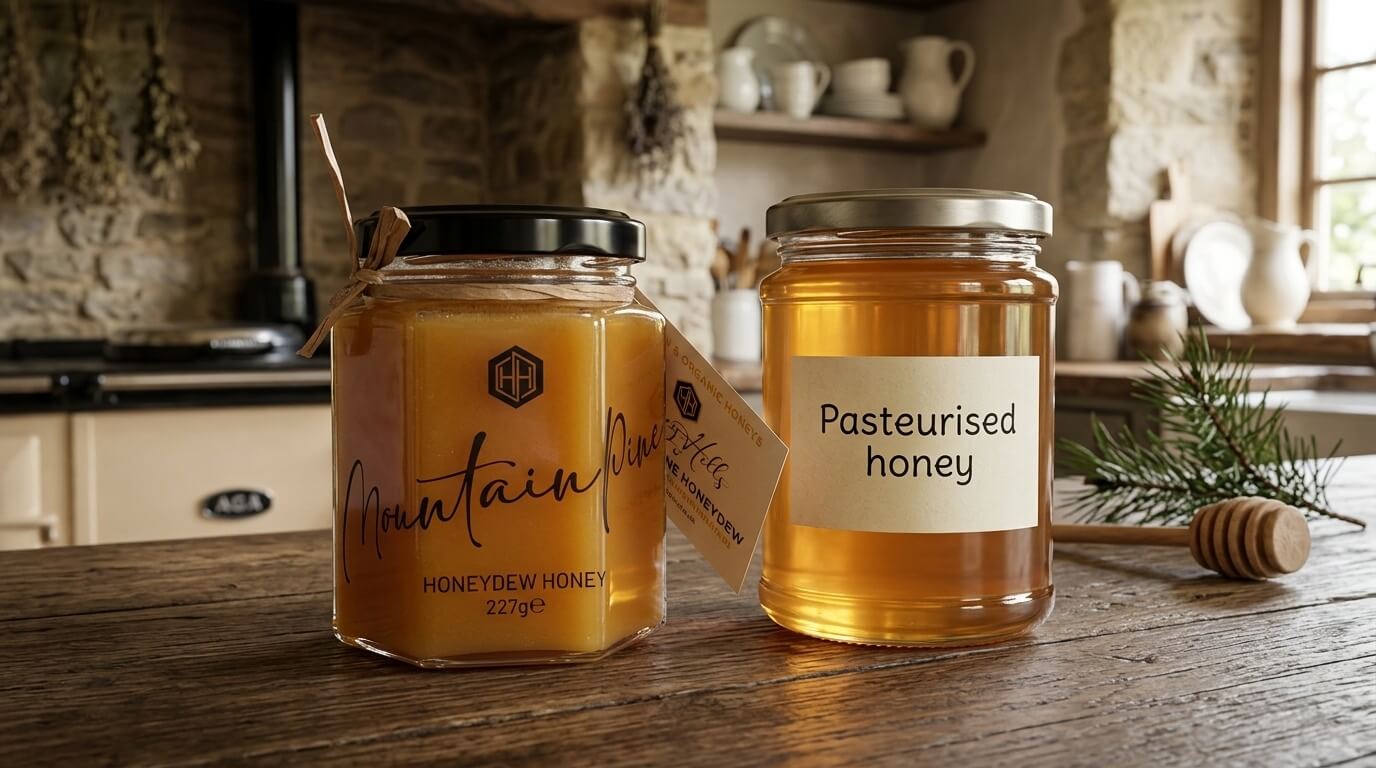
Raw vs Pasteurised honey
Walk into any supermarket and you'll find shelves lined with honey. It looks golden, it tastes sweet - so what's the difference between that and the raw honey specialists talk about? The answer goes deeper than you might expect, touching on flavour, nutrition, and the fundamental question of what honey actually is.
What is raw honey?
Raw honey is honey in its most natural state – extracted from the hive by cold-filtering or minimal processing, then bottled without heating. It retains everything the bees put into it: natural enzymes, pollen, propolis traces, and the full spectrum of aromatic compounds that give each variety its distinct character.
When honey is described as ‘unpasteurised’, it means it has never been heated above the natural temperature of a beehive (around 35°C). This distinction matters enormously for both flavour and nutritional content.
What happens to honey during pasteurisation?
Commercial honey is routinely heated to temperatures between 60°C and 70°C (sometimes higher) during processing. The reasons are practical: heat makes honey more liquid, easier to filter at speed, and slower to crystallise – all useful properties for large-scale production and long shelf life.
But heat is not kind to honey. The pasteurisation process destroys or significantly reduces the naturally occurring enzymes (including diastase and invertase), breaks down the delicate aromatic compounds responsible for varietal flavour, removes most of the pollen – eliminating the ability to trace the honey’s botanical origin – and accelerates the breakdown of antioxidants.
The result is a product that is technically honey, but has been stripped of much of what makes honey extraordinary.
Why does raw honey taste so different?
The difference is immediately obvious to anyone who tries a quality raw honey alongside a supermarket alternative. Raw honey has depth, complexity, and a lingering finish that varies dramatically depending on the flowers the bees visited. A raw acacia honey tastes nothing like a raw linden blossom honey or a raw Fir Honeydew.
Pasteurised honey, by contrast, tends towards a uniform sweetness. The subtle floral, herbal, or resinous notes that define each variety are largely lost.
Does raw honey crystallise?
Yes, and this is actually a sign of quality. Crystallisation is a natural process that occurs when glucose in the honey separates from the water and forms crystals. It does not mean the honey has gone off or been adulterated; in fact, pure raw honey crystallises more readily than heat-treated honey.
To return crystallised honey to a liquid state, simply place the jar in a bowl of warm (not boiling) water. Never microwave honey, as this will damage the very properties that make it valuable.
What sbout blended honey?
Most commercial honey sold in the UK is blended from multiple sources – often from several different countries – to achieve a consistent taste and texture at low cost. This blending makes it impossible to know the origin of what you’re eating, and the resulting honey rarely has any distinctive character.
Single-origin honey, by contrast, tells a story. Our Mountain Sumac honey comes exclusively from sumac blossom in the Carpathian foothills; our Wild Cherry Blossom Honey is collected only during the brief weeks that cherry trees flower in early spring. That specificity of origin is what makes the flavour remarkable.
Is raw honey safe to eat?
For healthy adults, raw honey is perfectly safe. The natural antimicrobial properties of honey – including its low water content, acidic pH, and hydrogen peroxide content – make it a hostile environment for most bacteria.
The one important exception: raw honey should not be given to infants under 12 months, due to the small risk of Clostridium botulinum spores, which a baby’s immature digestive system cannot safely process. This applies to all honey, raw or pasteurised.
How to choose a good raw honey
Look for honey that states its botanical origin clearly (acacia, linden, heather, etc.) and gives the region or country of production. Words like ‘cold-filtered’, ‘unpasteurised’, or ‘raw’ are encouraging signs. Independent quality awards, such as the Great Taste Awards judged by the Guild of Fine Food, provide a useful benchmark – all Honey Hills products are submitted for blind tasting, and we have won 14 Great Taste Awards to date.


